
Speed 3D Services · Published on September 17, 2026
Cockroaches and second-hand appliances: what to check
A refrigerator or a used oven can be a good deal, provided it also checks its sanitary condition. If you see a suspicious insect, stop the installation in the kitchen. Check out our page Treatment of roaches and roaches to have the clues identified and decide on the next steps. The challenge is to control a device entering the housing, without concluding that any second hand equipment would be infested.
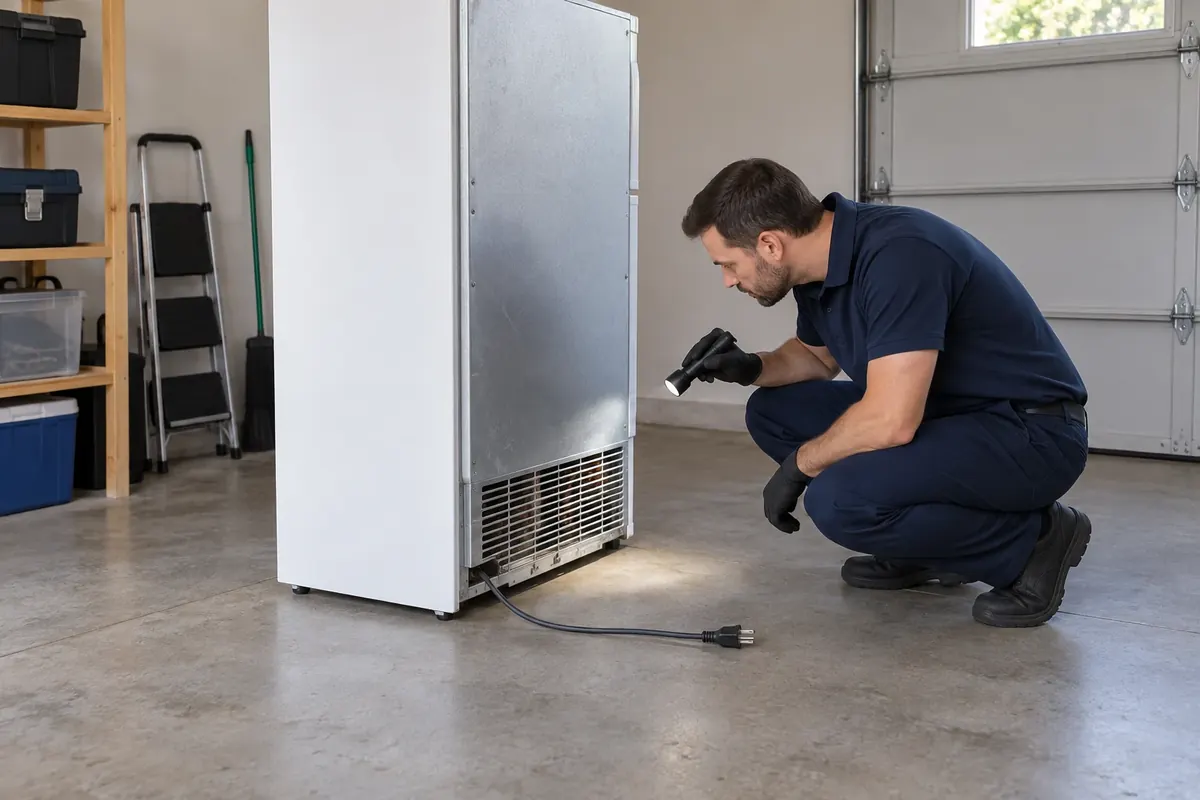
A clean interior does not tell all the story
The food compartment of a refrigerator can be impeccable while its external parts, interstices or technical areas have not been examined. Visible cleanliness is still useful, but it is not worth a certificate of absence of pests. An electric operating test also does not answer this question.
Before purchasing, ask where the device was used and stored. Did he stay in a cellar, garage or shared room? Has an insect treatment already been performed nearby? The seller may not have all the answers available. This lack of information must lead you to examine more, without accusing you of concealment.
The questions to ask the seller
Ask for photographs of the accessible underside, the back and the joints, in addition to the facade views. For a heavy device, do not ask for dangerous manipulation to get these images. Instead, propose a review when withdrawing, in safe conditions.
If the product is sold as repackaged, specify the checks performed. Cleaning, electrical repair and pest detection are different operations. Do not assume that an operating guarantee includes a specific pest control. You can request a document describing the device's preparation and the return conditions proposed by the seller.
Prepare your transport only after this exchange. Finding a problem when the refrigerator is already in a car loaded with cardboard complicates the decision. A planned inspection before loading limits unnecessary handling.
Examine without dismantling or spraying
Perform a visual inspection at the lamp, device stopped and disconnected. Look at the accessible areas without removing any technical panel: joints, contours, feet, external grids and visible bottom. Do not tilt a heavy device alone and do not touch the internal components.
A living insect is a clue to be identified. Small debris, a dark trace or a smell have several possible causes. Photograph their location before cleaning. It is more useful to transmit a contextualized image than a blurred close-up without indicating the area concerned.
| Observation | Prudent interpretation | Recommended Suite |
|---|---|---|
| Insect visible near a grid | Identification required | Delay loading or installation |
| Dark traces or debris | Salissure or possible biological index | Photographing and requesting an examination |
| No visible anomaly | No index at check | This is not an absolute guarantee |
| Product already sprayed in the apparatus | Compatibility and residues to be verified | Ask for the product name and the opinion of a professional |
Do not spray an aerosol in openings to "test" the presence of cockroaches. No powder, steam, or liquid is introduced into the electrical parts. A product authorized for certain uses is not necessarily suitable for the interior of an appliance or surfaces in contact with food. The Ministry recalls the specific framework of the biocidal products.
If the device is already at home
Limit the successive movements between the pieces. Record the journey from the delivery and the places where the aircraft was placed. Keep photographs and vendor information. If an insect has been observed, specify if it was in the device, under or on a packaging: this difference helps to guide the inspection.
Do not turn a common garage or cellar into an improvised waiting area without warning the persons concerned. Suspicious equipment must be managed with a plan, particularly for its movement, possible packaging and storage conditions. Never lock an operating device in a packaging that obstructs its ventilation.
The professional will be able to evaluate the device and its immediate environment. A repairer may be required if access to the technical parts requires disassembly. The pest control company and the repairer have complementary roles; the intervention of one does not automatically replace that of the other.
Keeping, getting processed, or giving up buying?
The decision depends on the identification, accessibility of the areas concerned, the value of the device and the possibility of compatible treatment. A low purchase price loses its interest if controls, transport and repairs become disproportionate. Ask for a detailed proposal before hiring several separate benefits.
If you give up a suspect device already acquired, inform the owner of the situation. Do not give it by presenting it as healthy and do not place it in a common passage. Organize its recovery or collection according to local rules, specifying the problem observed.
In Lyon, the municipality presents Life in Rhônea reconditioning and repair structure. This example shows the interest of an identifiable interlocutor in purchasing and tracking; it does not constitute a guarantee of absence of cockroaches applicable to all devices.
Frequently asked questions
Does the cold in the refrigerator eliminate cockroaches?
Operating the aircraft does not cover all its external and technical areas. Do not confuse the temperature of food storage with a whole equipment insect control protocol.
Should we throw away a device after seeing a single insect?
No, the first step is identification. An occasional insect does not necessarily call the same response as an infestation installed. Also avoid immediately repositioning the device because the insect is no longer visible.
Can we sell it after a cleanup?
An aesthetic cleaning does not demonstrate the elimination of a pest control problem. Clarify its condition and honestly inform the future purchaser of the observations and actions carried out.
To have a suspicion reviewed before installation, contact Speed 3D Services at 04 26 84 07 35, at 06 44 68 80 08 or to info@speed-3d-services.com. In your diagnostic request, indicate the type of device, its location and the indices observed.