
Flies returning to an attic in autumn in Grasse
When you open a room under the roof, you discover flies grouped close to a window, sometimes with dead individuals on the ground. In a house in Grasse, this situation deserves a different search than that carried out around a kitchen bin. Check out our disinectation service to prepare an identification and report where flies reappear. The objective is to understand the grouping before deciding on a treatment.
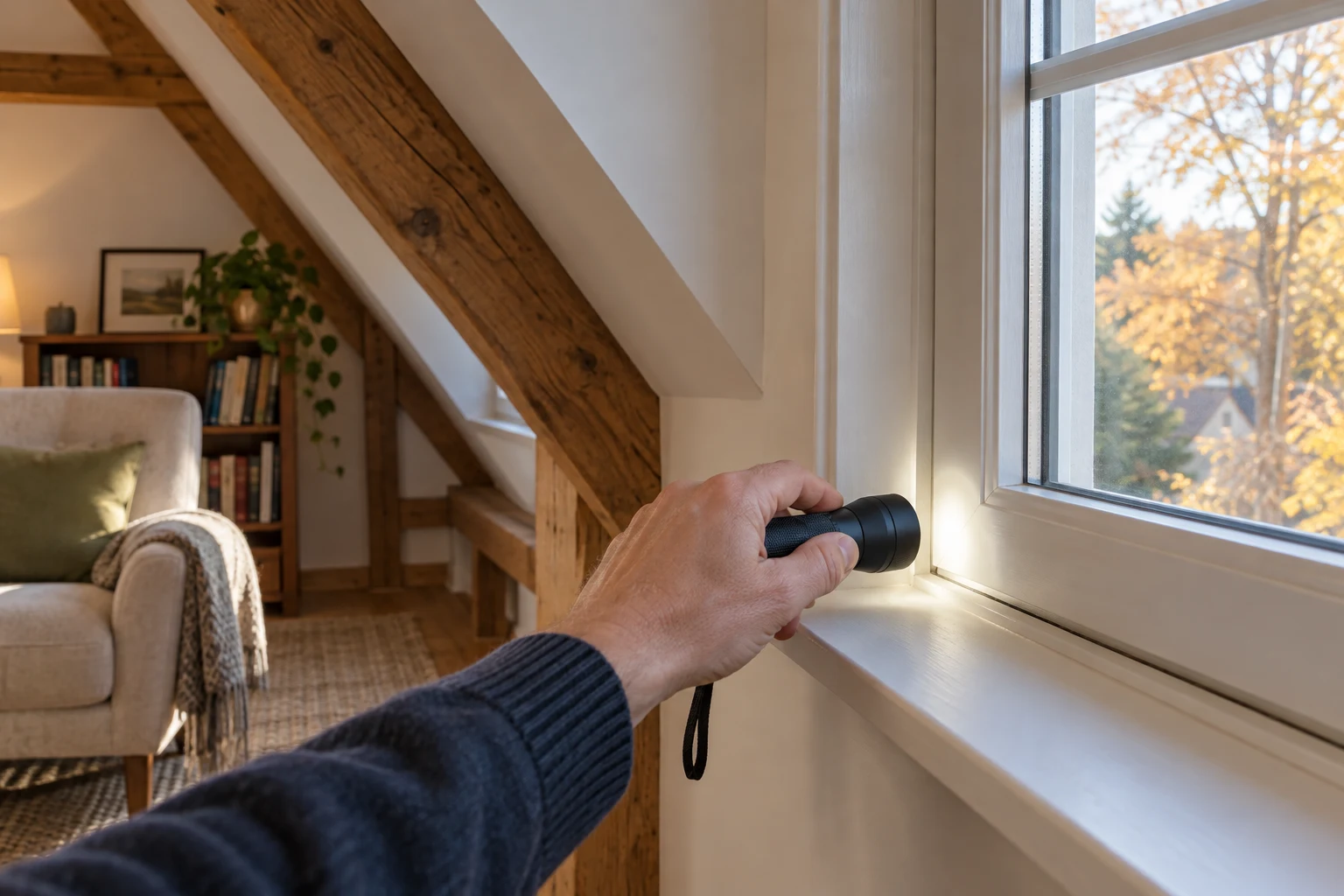
Image generated by IA: inspection of a window accessible from a furnished room. It does not represent an intervention in Grasse.
Why does the problem come back at the same time of year?
I'm not sure what I'm doing.Office for Insects and their Environment explains that some flies, such as Pollenia rudis, spend the winter in buildings and can gather there. He also cites Musca autumnalis, a different species likely to share shelters. The common name "attic fly" is therefore not always sufficient to identify the individuals present.
A grouping near a glass in the fall guides the examination, but does not confirm the species alone. Photograph the flies closely and note whether the phenomenon is seasonal or permanent. A concentrated presence in the attic, a appearance around food and a discovery associated with an unusual smell should not automatically receive the same response.
Do not conclude with a "nest" in the frame because several flies are gathered in the same place. The visible clustering point and the penetration point in the building may be different.
Reconstitute the journey without dismantling the attic
Start with the areas accessible from a stable ground: window frame, junction between wall and carpentry, hatch and visible formwork. Identify accumulations and photograph them before cleaning. This will allow you to show their exact location to the speaker.
Outside, observe only what is visible from the ground. Do not climb on a roof or walk on a floor of attices whose strength is unknown. Part of the diagnosis may require a professional in the building equipped to access the area.
| What You See | What needs to be clarified | What should not be concluded too quickly |
|---|---|---|
| Moths near a window in autumn | Exhibit, dates, approximate number | That the window is necessarily the only entrance |
| Returns after cleaning | Time and point of reappearance | That cleaning caused the arrival |
| Presence in several rooms | Flooring and communication between rooms | That the whole house needs to be sprayed |
| Unusual smell or other visible source | Location and evolution | That they are necessarily wintering flies |
If a different source is suspected, expose it from the first contact. A diagnosis centered solely on windows could miss another problem.
Clean to observe new apparitions
Remove accessible individuals with a surface-compatible method, such as a conservative suction. Then manage the contents of the vacuum cleaner in accordance with its package leaflet, without spreading it into another room. Cleaning is used to find a legible starting state; it does not guarantee that no flies remain in an inaccessible space.
Do not spray at random in closed ducts, electrical installations, insulations or chests. A difficult place to reach does not justify the improvised use of a product. Also notify the provider if you have already used an aerosol or diffuser, keeping the name of the product.
After cleaning, follow the same checkpoints. A photo dated from the window and the ground area is often enough to document a return. For an occupied residence only some weekends, distinguish the date of discovery from the supposed date of appearance: you cannot deduct a recent massive arrival of accumulation for several weeks.
Correct access without condemning ventilation
Prevention must respect the function of the building. A degraded window joint and a ventilation grid are not corrected in the same way. The first may require repair; the second must continue to ensure the planned air renewal.
Protection against insects on a technical opening shall be chosen and laid in a manner consistent with its flow rate, maintenance and installation requirements. Do not close all visible slots with foam without knowing what they are for. Ask the professional to distinguish between the passages to be repaired and the openings to be kept.
For an old house or attic transformed in Grasse, prepare the information you have about the latest work: window replacement, safe resumption, ventilation modification. This is evidence to be examined, not evidence that the work is responsible.
What should a proposal for intervention specify?
Ask what identification has been selected, which areas are accessible and what actions are relevant to the building. If a treatment is proposed, specify the surfaces concerned, the instructions for the occupants and the control provided. These elements make it possible to compare proposals which do not necessarily cover the same work.
A delay, a number of visits or a result cannot be guaranteed from the word "flies". An appropriate intervention must take into account the observed grouping and the possibility of access to the points concerned.
Should we throw out the insulation?
Flies found on the ground are not enough to justify the replacement of insulation. The condition of the materials must be examined separately before a costly decision is made.
Why do we still see them after we've picked up everything?
Individuals may become visible from another area of the building. Note where they appear: this information is more useful than an immediate repeat of the same product.
For a request to Grasse, please contact the type of attic, access conditions and photos to info@speed-3d-services.com, or contact Speed 3D Services 06 44 68 80 08.
Useful links
| Resource | Utility |
|---|---|
| Speed 3D Services | Describe the problem and prepare an application |
| OPIE: flies grouped in a building | Understanding the wintering of certain species |