
Ticks in a home with a dog: checks and who to contact
You found a tick near the dog's basket, and then another one on a plinth? In the Alpes-Maritimes, one has to distinguish a spot discovery from a repeated presence in the dwelling. Check out our disinectation page to prepare for the examination of the domestic environment. At the same time, ask your veterinarian for advice on the animal: an intervention in the house does not replace his care.
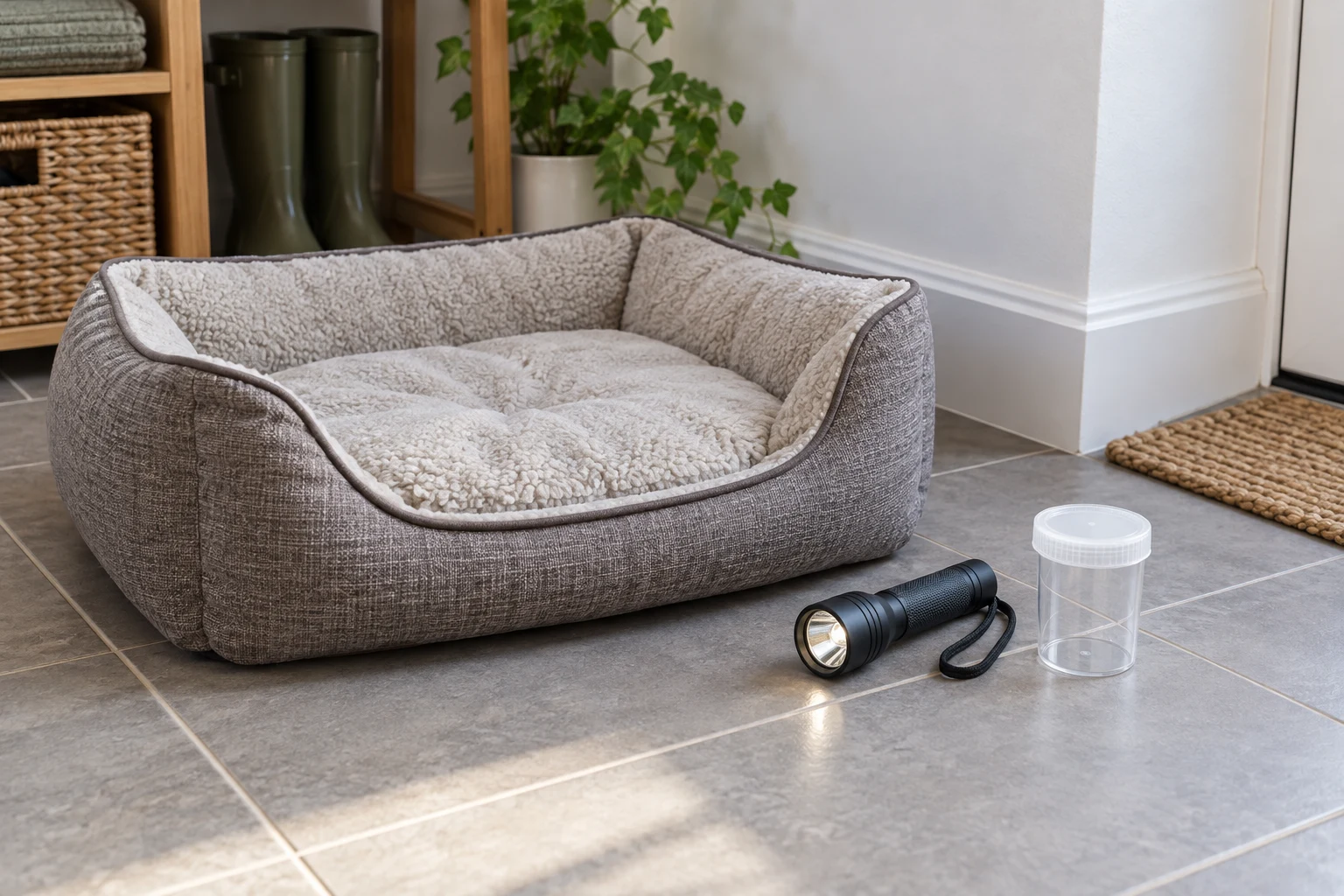
IA-generated illustration: preparation of an inspection around a sleeping area. No animals or specimens are represented.
A tick found on the ground does not prove an infestation
Ticks are mites, not insects. Some can be reported from outside. But...ESCCAP France indicates that Rhipicephalus sanguinus, which is present in south-eastern France in particular, can complete its cycle in dwellings or kennels. This is why repeated discoveries justify identification and environmental examination.
The colour or size of a single individual does not allow the individual to confirm the species. Photograph the specimen without manipulating it with bare hands, record its location and ask the professional how to keep it if an examination is required. An image too blurred may leave the diagnosis uncertain; it is better to recognize this limit than to choose a treatment on a supposition.
Do not automatically associate each tick with Lyme disease. The assessment of a bite and possible symptoms is the responsibility of a healthcare professional, regardless of the diagnosis of the dwelling.
The three interlocutors do not have the same role
| Situation | Interlocutor | Information to be prepared |
|---|---|---|
| Tick on the dog or question about its protection | Veterinary | Animal concerned, product already used, date of application |
| Ticks found several times in the rooms | Professional pest control | Photos, dates, locations, animals |
| Tick fixed to a person or symptoms after bite | Health professional | Date, likely place of exposure, trend of signs |
For one person,Sickness Insurance recommends quick removal with a tick, without applying any product in advance, then a surveillance of the area for a month. A redness that spreads, fever or other unusual symptoms require medical advice. Check out his card for detailed gestures and special situations.
Mapping the observations in the house
Draw a simple plan of the pieces. Mark each discovery with its date and specify whether the specimen was on the animal, textile or ground. Keep separate the observations made after a walk and those made in a room where the dog had not recently passed.
Look at the accessible edge of the bed, the junctions between the floor and the wall and the places frequented by the animal. Do not remove all the plinths until you have received instructions: this operation may complicate the tracking and is not always necessary. An accessible observation is better than risky handling of heavy furniture.
In a house with a garden, mention the outdoor resting places and any recent changes: new animal, pension return, sleeping shift. This information guides the questions to be asked. They do not automatically refer to the source of the presence.
Preparing housing without improvising treatment
Avoid moving the basket and its textiles from piece to piece to "put the problem elsewhere". Keep the items concerned together pending proper instructions for their maintenance. For a washable textile, follow the label and ask what measures are relevant for the identified case; a randomly selected cycle is not equivalent to elimination protocol.
Never apply a product intended for the building to the animal. Do not transpose a veterinary prescription from one animal to another. Report cats, young animals and other occupants of the accommodation to the veterinarian and the attending party so that they can give appropriate instructions.
If a habitat intervention is selected, ask for instructions in writing: preparation, affected areas, exit and return conditions, post-pass maintenance and follow-up. The coordination of actions on animals and their environment avoids everyone assuming that the other has already dealt with the whole problem.
In the Alpes-Maritimes, what information should be given for a quote?
Specify the municipality, the approximate area, the number of rooms involved and the existence of a garden or a kennel. Distinguish the surfaces to be examined from those where a presence has actually been observed. A large house with an isolated discovery and a small dwelling with recurring observations do not constitute the same file.
For property entrusted to a manager, indicate who can open the dwelling and pass instructions to the occupants. In a secondary residence, designate a person who is able to perform the controls agreed upon after the crossing. These practical details are important to organize the work without promising a delay or a number of treatments in advance.
Monitoring the situation after the first steps
Keep the same record of observations before and after the intervention. Report new discoveries with their location and date. The duration of follow-up will depend on the identification and protocol chosen; a few days without observation alone do not constitute proof of complete elimination.
Should we treat the whole house after a single tick?
Not automatically. The identification, context and repetition of observations should guide the decision. First ask for a veterinary opinion for the animal and describe precisely the discovery.
Is a dog product enough for housing?
It does not make it possible to conclude that the environment has been taken care of. If the findings are repeated, have the accommodation examined separately while continuing the veterinarian's recommendations.
To submit a situation in 06 to Speed 3D Services, call the 06 44 68 80 08 or write to info@speed-3d-services.com. Attach your statement and photos available.
Useful links
| Resource | Utility |
|---|---|
| Disinfection and housing review | Preparing an Environmental Application |
| ESCCAP France : dog and cat ticks | Veterinary information on ticks |
| Ameli: what to do after a tick bite? | Human health guidelines |