
Woodlice in a ground-floor home in Antibes: entry points
Do you find cloportes near the bay window, in the entrance or under a piece of furniture on your garden floor in Antibes? Our disinectation page allows you to prepare an identification application before considering treatment. For these small crustaceans, it is often more useful to look at the passage between the garden and the house than to start by spraying all the plinths.
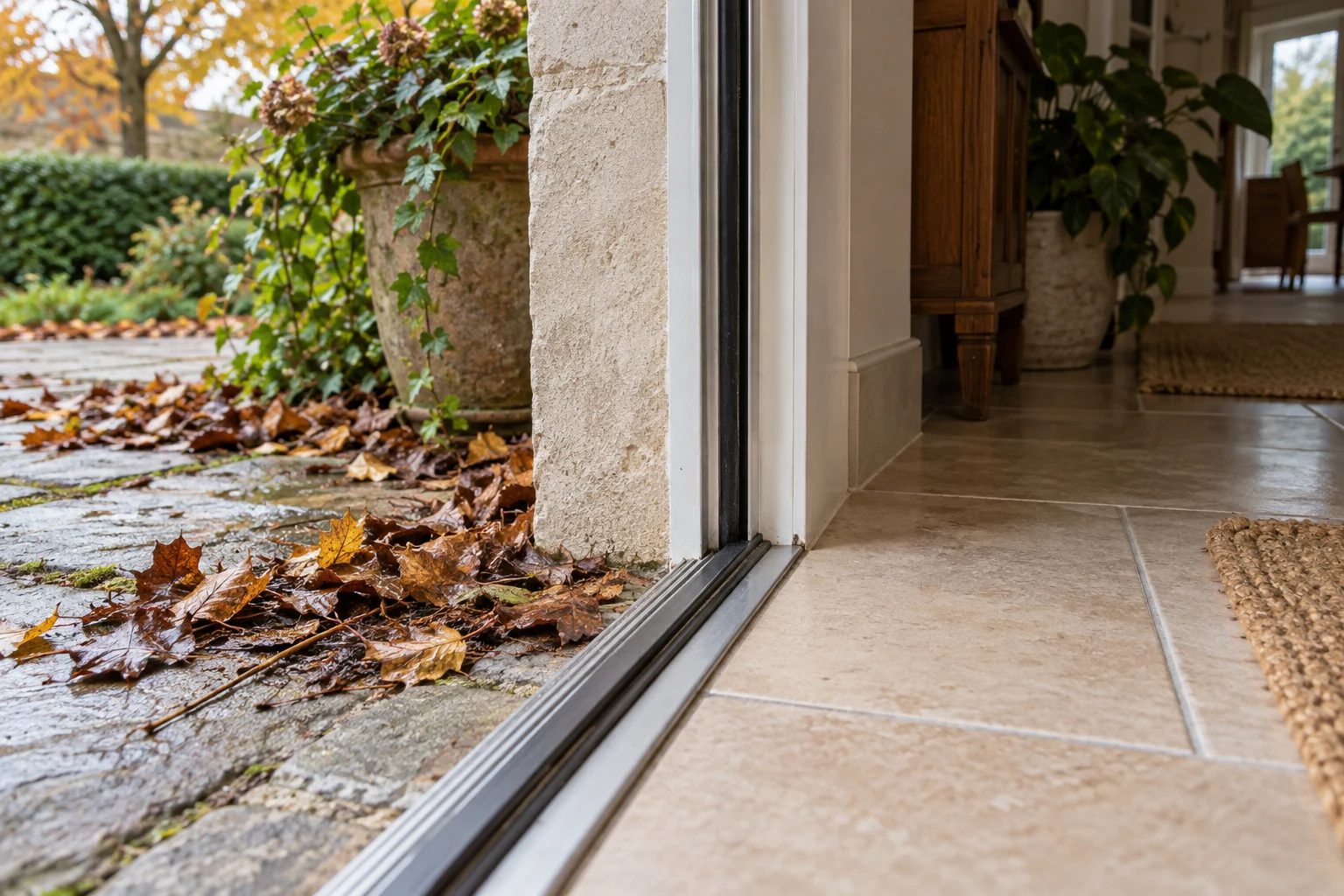
Image generated by IA: example of an outside area to be examined near a threshold. No actual construction site is represented.
The clogate is a crustacean, not a cockroach
I'm not sure what I'm doing.INRAE describes the clogates like crustaceans with a segmented body, with seven pairs of legs. They participate in the decomposition of organic matter, including dark refuges under leaves or wood. This function in the garden does not justify their systematic elimination around a dwelling.
A clean photo can guide the identification. If the observed organism has another silhouette or moves differently from what you expected, do not choose a product on the sole basis of the word "straw". The same apartment can also accommodate several species without having the same origin.
The presence of a few individuals near a door does not establish a widespread infestation. Nor does it prove that the walls are degraded. The frequency and location of the observations will be more useful than the number discovered during a single cleanup.
Make an inspection journey from outside to inside
In a garden ground, start on the terrace. Look at the leaves accumulated against the threshold, pot saucers, objects placed in contact with the wall and areas that remain wet. Move only items that you can handle safely. Do not intervene on a collective evacuation or a facade without identifying the person responsible for the equipment.
Continue with the door sleeper, visible joints and accessible pipe passages. Inside, note if the cloports remain concentrated near this access or if you find them regularly in another room. This distinction helps to separate a one-off entry from a problem to look for further in the housing.
| Area | What to note | Priority action |
|---|---|---|
| Terrace in front of the bay | Leaves, persistent water, backed objects | Clear and clean accessible approaches |
| Threshold and joints | Game visible, joint damaged, passage spotted | Examine the closure or joint |
| Under-sink cabinet | Humidity, visible leakage, degraded background | Search and repair the cause of water |
| Common corridor | Observations outside housing | Inform the trustee with photos and dates |
Do not confuse a crack to be repaired with an opening intended for ventilation or drainage of water. Obture of the latter could create another problem. If you do not know the function of an orifice, check it before butchering.
The first actions must remain proportionate
You can collect the accessible individuals with a container and move them out, immediately away from the front door. Clean visible dirt and residues, then dry surfaces compatible with this operation. The aim is not to sterilize the garden, but to make what is happening at the edge of the house more legible.
Reorganize objects stored against walls when they prevent any inspection. A stack of pots or an outside storage shall not permanently hide the bottom of a bay. If water remains present after cleaning, note when it appears: after watering, after rain or even during dry periods. This information will be useful to the professional who will review the development.
Avoid product mixes and widespread powders without diagnosis in living rooms. The fact that a product is presented as "natural" does not demonstrate its interest in your situation or its compatibility with occupants and materials.
How can we check that the situation is improving?
Choose two or three control points: the threshold, an angle of the room and a previously affected area. Look at them in comparable conditions, for example during your usual cleaning. Note the new observations without constantly moving all the furniture.
If the apparitions always concentrate in the same place, return to this passage rather than treat the whole house. If they move to more than one room, complete your statement and have the identification confirmed. An evolution must be used to guide the research, without being interpreted as automatic proof of success or failure of a product.
In Antibes, organize the visit of a garden ground
Indicate whether you have a private garden, a terrace overlooking common areas or direct access to a cellar. This information describes the place to be examined; it does not mean that the whole neighbourhood must be treated. For a rental, notify your usual contact if a building defect is visible. In a condominium, outside access may require the presence of the custodian or the manager's agreement.
Before you ask for a quote, gather a close photo, a threshold view and return dates. A advertised tariff without knowing the organization, access and work would be of little value. A visit can lead to advice on repair or maintenance adjustment rather than product application.
Should we treat the whole garden?
This is not a conclusion to be drawn from a few cloportes in the entrance. The investigation begins with the passage concerned and the conditions close to the dwelling.
Can we confuse cloports with wood insects?
A discovery on a plinth does not prove that the animal attacks the wood. Photograph separately any holes or degradations to avoid linking two observations without proof.
To present your situation to Speed 3D Services, contact 06 44 68 80 08, 04 26 84 07 35 or info@speed-3d-services.com, specifying Antibes and access to the ground garden.
Useful links
| Resource | Utility |
|---|---|
| Antibes insectization | Present the local context of your application |
| Cloportes: INRAE card | Understanding their role and habitats |